
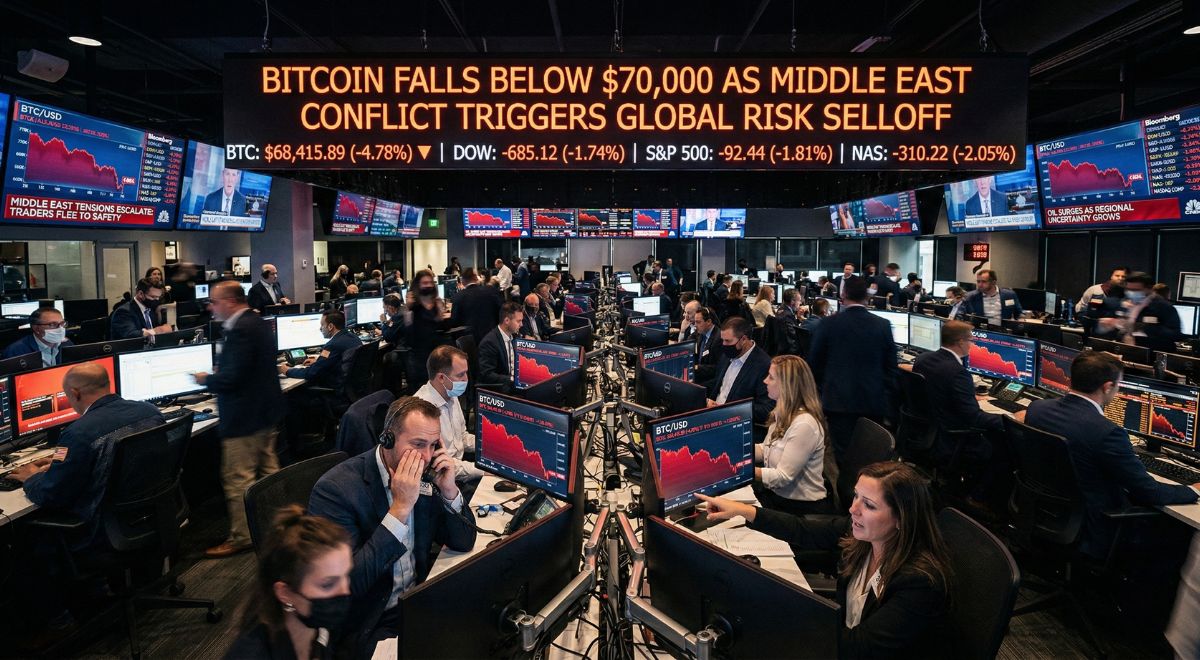
The cryptocurrency market faced renewed turbulence this week as Bitcoin sinks below $70,000 as Middle East conflict sparks risk selloff, reflecting a broader retreat from risk assets amid escalating geopolitical tensions.
Table of Contents
ToggleBitcoin Drops Under $70,000
Bitcoin fell sharply, breaking below the psychologically significant $70,000 level as investors reacted to rising instability in the Middle East. The move marked one of the most notable pullbacks in recent months, erasing a portion of the gains accumulated during its strong rally earlier this year.
The decline coincided with heightened military tensions in the region, which triggered volatility across global financial markets. Traders moved quickly to reduce exposure to high-risk assets, including cryptocurrencies and equities, opting instead for traditional safe havens.
Risk-Off Sentiment Grips Global Markets
The selloff in Bitcoin reflects a broader “risk-off” shift. Historically, geopolitical crises tend to drive investors toward assets perceived as more stable during uncertainty.
Gold prices climbed as demand for defensive assets increased, reinforcing its long-standing reputation as a crisis hedge. Meanwhile, global stock indices also saw declines, particularly in technology and growth sectors that are typically more sensitive to shifts in market sentiment.
Although Bitcoin has often been promoted as “digital gold,” its recent price action suggests that investors still largely treat it as a risk asset rather than a safe haven during acute geopolitical shocks.
Volatility Highlights Bitcoin’s Dual Narrative
Bitcoin’s drop below $70,000 underscores an ongoing debate within the investment community: Is it a hedge against instability, or does it behave more like a speculative technology asset?
During periods of liquidity expansion and bullish sentiment, Bitcoin tends to outperform. However, when markets are gripped by sudden uncertainty — such as escalating military conflicts — capital frequently rotates into more traditional stores of value.
The latest downturn also triggered liquidations in leveraged crypto positions, amplifying downward pressure and accelerating price declines. Analysts note that derivatives markets often magnify volatility during sharp moves.
What Comes Next?
Market participants are now closely monitoring developments in the Middle East, as further escalation could extend volatility across financial markets. A stabilization of geopolitical tensions may help restore investor confidence and support a rebound in crypto prices.
For now, Bitcoin’s slide below $70,000 serves as a reminder that despite its growing institutional adoption and maturing infrastructure, it remains sensitive to global macroeconomic and geopolitical shocks.