
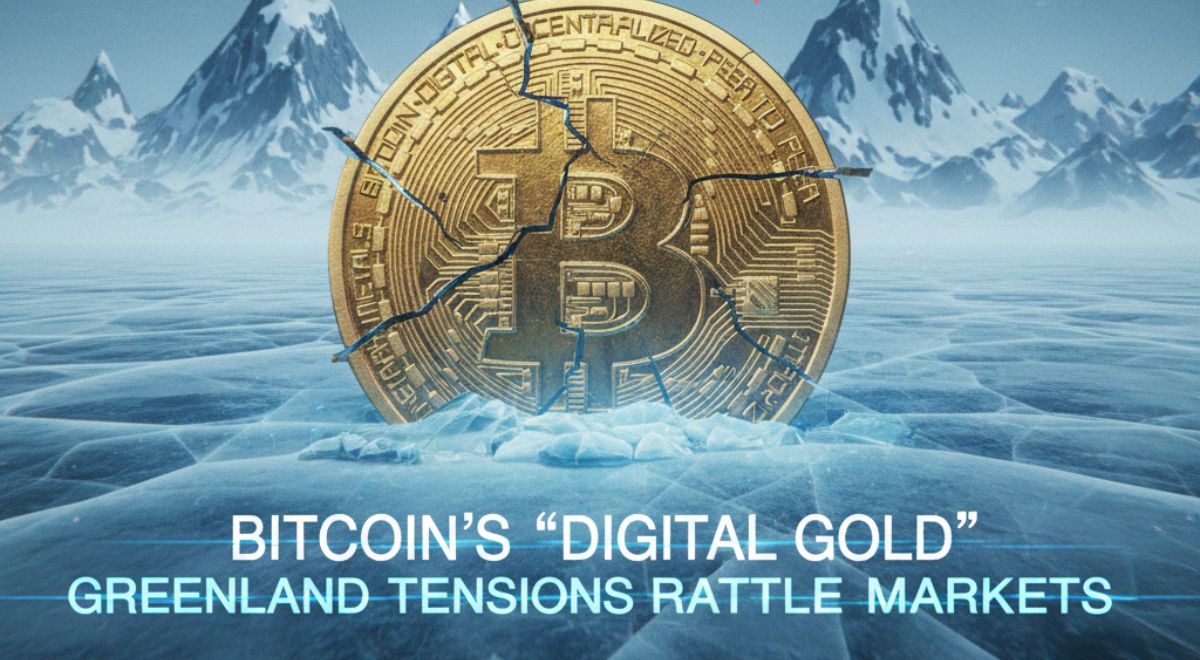
Bitcoin’s long-standing narrative as “digital gold” — the idea that it acts as a safe-haven store of value like physical gold — has come under fresh pressure this week as renewed geopolitical tensions linked to Greenland rattled global markets and reshaped investor sentiment.
Table of Contents
ToggleGeopolitical Shockwaves: Greenland and Trade Tensions
The catalyst for the market movement was a diplomatic and trade dispute sparked by U.S. President Donald Trump’s threat to impose tariffs on Denmark and several European Union countries unless they agreed to U.S. terms over the strategic territory of Greenland. The threat of a new 10% tariff — potentially rising to 25% — sent shockwaves across financial markets, prompting sharp rallies in traditional safe-haven assets and renewed risk aversion among investors.
As fear and policy uncertainty rose, commodities like gold and silver surged to record highs, with gold crossing historic price levels and silver also climbing dramatically as investors sought refuge from volatility.
Bitcoin’s Price Reaction
In contrast to the rally in precious metals, Bitcoin slipped back toward the $92,000 range during the height of the market upheaval. Trading activity on decentralized prediction markets reflected diminished confidence; the odds of Bitcoin reaching $100,000 by the end of January plunged sharply as traders re-evaluated risk sentiment.
The price decline wasn’t isolated — the broader crypto market also felt the impact, with many altcoins and sector indexes showing notable losses during the same period.
What This Means for the “Digital Gold” Narrative
Bitcoin’s muted response to a major geopolitical event stands in stark contrast to the behaviour of traditional safe-haven assets. While gold and silver rallied strongly, Bitcoin’s weaker performance — and its continued tight correlation with risk assets like equities — highlights a key divergence. This challenges the premise that Bitcoin reliably attracts capital during periods of macroeconomic stress.
Analysts point out that — rather than acting as a crisis hedge — Bitcoin has behaved more like a risk-sensitive speculative asset in recent market turmoil. When uncertainty spikes, investors appear more willing to flock to tangible, historically proven hedges than to digital assets with shorter track records.
Underlying Market Dynamics
Despite the recent weakness, there are signs that institutional interest in Bitcoin hasn’t disappeared entirely. Spot Bitcoin and Ethereum ETFs saw strong capital inflows in the week leading up to the sell-off, signalling that some larger players remain optimistic about the long-term outlook. However, whether these flows are enough to sustain upward momentum amid broader macro stresses remains to be seen.
Furthermore, ongoing accumulation by large holders — often referred to as whales — suggests that supply dynamics could tighten over time, potentially setting the stage for renewed volatility or upside if risk appetite returns.
Outlook: Risk Appetite vs. Safe Haven Demand
Ultimately, the recent episode underscores a central truth about Bitcoin’s role in financial markets: its identity is still evolving. The “digital gold” label may capture Bitcoin’s long-term store-of-value potential, but in moments of acute geopolitical stress, it hasn’t yet displaced traditional hedges in investor portfolios. Instead, its price movements continue to reflect broader economic sentiment and liquidity dynamics, rather than a pure flight-to-safety appeal.
As markets continue to grapple with trade uncertainties and inflationary pressures, the coming weeks will be critical for testing whether Bitcoin can reclaim its defensive aura or if its safe-haven narrative needs refining to reflect its true behavior in turbulent times.