
Photo Credit: fxstreet
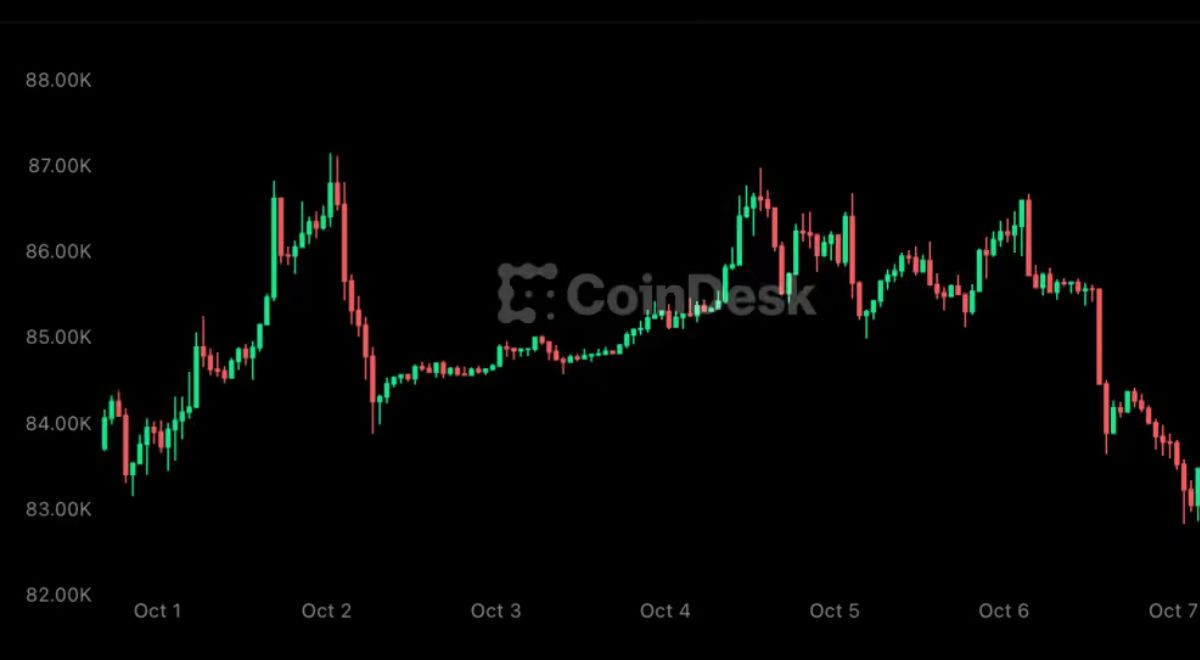
Bitcoin (BTC) slipped more than 2% on Thursday, October 22, trading below $83,000 as escalating geopolitical tensions in the Middle East weakened investor confidence, despite renewed institutional demand and continued inflows into spot Bitcoin exchange-traded funds (ETFs).
The world’s largest cryptocurrency was trading near $82,287 during Thursday’s session, putting its gains from earlier in the week at risk. While institutional investment has shown signs of recovery, growing uncertainty surrounding regional security developments has limited Bitcoin’s ability to sustain its recent rebound.
The decline highlights the competing forces influencing the cryptocurrency market, with stronger institutional participation providing support while geopolitical risks continue to affect demand for risk-sensitive assets.
Bitcoin ETF Inflows Signal Renewed Institutional Interest
Institutional demand for Bitcoin has strengthened this week, with US-listed spot Bitcoin ETFs attracting fresh capital after two consecutive weeks of net withdrawals.
According to SoSoValue data cited in the market report, spot Bitcoin ETFs recorded approximately $528.40 million in net inflows on Wednesday, marking their third consecutive day of positive flows.
Total weekly inflows surpassed $1 billion through Wednesday, suggesting that institutional investors are returning to the market despite ongoing price volatility.
COINOTAG
Sustained ETF inflows could provide additional support for Bitcoin prices, particularly if investor demand continues to increase in the coming sessions. However, analysts remain cautious about whether the current pace of investment will be sufficient to drive a sustained recovery.
Switzerland Approves First Spot Bitcoin ETF
In another development supporting institutional cryptocurrency adoption, BIT Asset Management AG, the Swiss subsidiary of digital asset company BIT, received regulatory approval to introduce a spot Bitcoin ETF.
The Swiss Financial Market Supervisory Authority (FINMA) approved the Bitcoin Fund ETF, which will trade under the ticker BBIT.
The fund is expected to begin trading on Switzerland’s SIX Swiss Exchange in November 2026, offering retail and institutional investors exposure to Bitcoin through a regulated investment product.
FINMA confirmed that the newly approved fund is Switzerland’s first exchange-traded investment fund permitted to invest directly in Bitcoin. BIT Asset Management also described the product as Europe’s only spot Bitcoin ETF under its applicable fund structure.
FINMA
+2
The development could expand access to digital assets through conventional investment accounts, potentially supporting broader participation in the cryptocurrency market.
Nevertheless, FINMA warned that Bitcoin investments remain highly volatile and that regulatory approval does not eliminate the possibility of substantial financial losses.
Middle East Conflict Adds Pressure to Cryptocurrency Markets
Geopolitical developments in the Middle East have emerged as a significant source of uncertainty for global financial markets, contributing to Bitcoin’s latest decline.
According to Reuters, Iran’s Islamic Revolutionary Guard Corps (IRGC) Navy reported on Thursday that four vessels allegedly involved in illegal oil transfers were struck and caught fire in the northern Persian Gulf after being tracked by Iranian forces on Wednesday.
The IRGC also claimed that three additional vessels struck naval mines west of the Strait of Hormuz.
Iranian authorities warned that further US military provocations could trigger a broader response against American military facilities in the region.
Reuters
+1
Iranian Foreign Minister Abbas Araghchi separately reiterated Tehran’s willingness to engage in diplomatic discussions while maintaining the country’s readiness to defend itself.
However, Araghchi expressed doubts about achieving meaningful progress, citing what he described as Washington’s unwillingness to reach an understanding.
The original market report also cited a New York Times account of alleged US and Israeli planning for a short military campaign against Iran following the US midterm elections. That specific claim has not been independently verified here.
The developments have intensified concerns about regional stability, particularly around the Strait of Hormuz, a strategically important passage for international energy shipments.
As geopolitical uncertainty increases, investors may reduce their exposure to volatile assets, including cryptocurrencies, potentially limiting Bitcoin’s near-term recovery.
Bitcoin Price Analysis: $85,000 Remains a Key Resistance Level
Bitcoin’s technical outlook indicates that the cryptocurrency remains within a broader positive price structure, although short-term momentum has weakened.
At the reported price of $82,287, BTC was trading above its 50-day, 100-day and 200-day exponential moving averages (EMAs), suggesting that longer-term support levels remain intact.
However, momentum indicators point to a more cautious market environment.
The Relative Strength Index (RSI) stood near 49, reflecting relatively balanced buying and selling pressure. Meanwhile, a negative Moving Average Convergence Divergence (MACD) histogram suggested that bullish momentum had slowed.
The combination indicates that Bitcoin may continue consolidating unless fresh buying demand or improving market conditions support another upward move.
Key Bitcoin Support and Resistance Levels
Technical level BTC price
Immediate resistance $85,000
Current reported price $82,287
50-day EMA support $80,873
100-day EMA support $77,458
200-day EMA support $76,138
A sustained move above $85,000 could strengthen bullish sentiment and open the door to further gains.
Conversely, a decline below the 50-day EMA near $80,873 could expose Bitcoin to additional selling pressure, with the next important support levels around $77,458 and $76,138.
A decisive breakdown below these longer-term averages could weaken the prevailing bullish structure and increase the likelihood of a deeper correction.
Bitcoin Outlook Remains Dependent on ETF Demand and Geopolitical Developments
Bitcoin’s near-term direction is likely to depend on whether institutional inflows can offset the negative effects of geopolitical uncertainty.
Continued investment in spot Bitcoin ETFs, combined with Switzerland’s latest regulatory development, could strengthen market confidence and support broader adoption of digital assets.
However, further escalation in the Middle East may encourage investors to adopt a defensive approach, restricting cryptocurrency gains.
For now, traders are likely to monitor Bitcoin’s ability to remain above the $80,873 support level while watching for a potential recovery toward the $85,000 resistance zone.
A sustained improvement in institutional demand and easing geopolitical tensions could provide the conditions for another upward move, while renewed market uncertainty may leave Bitcoin vulnerable to additional price fluctuations.