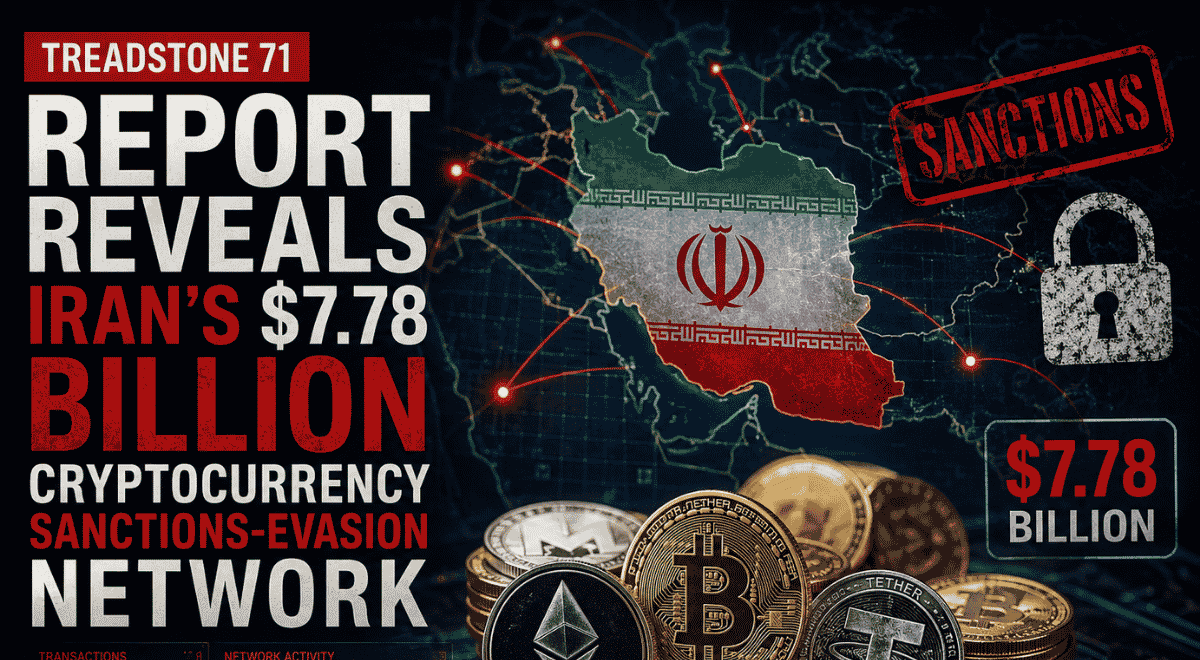
DUBAI — Iran has increasingly turned to cryptocurrency as a tool to navigate international sanctions, move oil revenues and support overseas operations, according to a new intelligence assessment by Treadstone 71.
The August 2026 report estimates that cryptocurrency addresses linked to Iran received more than $7.78 billion in 2025, with networks associated with the Islamic Revolutionary Guard Corps (IRGC) accounting for more than $3 billion of that activity by the fourth quarter.
The assessment, which draws on blockchain analytics including data from Chainalysis, identifies Tether (USDT) on the Tron blockchain as a key component of Iran’s digital financial infrastructure.
Table of Contents
ToggleSeven-Layer Network Used to Move Funds
According to Treadstone 71, Iran’s cryptocurrency operations form a complex shadow-banking network connecting oil sales, offshore companies, cryptocurrency exchanges and digital wallets.
The report says Iranian oil revenues are frequently routed through front companies, including entities operating in Hong Kong and the UAE, before being converted into USDT. The funds can then pass through multiple intermediary wallets before being converted back into traditional currencies.
Treadstone 71 identifies Tether’s ability to freeze specific USDT addresses as the most significant potential point of intervention within the network.
The report argues that other parts of the system can generally be replaced or bypassed, making stablecoin issuers an important focus for sanctions enforcement.
Nobitex Emerges as a Major Crypto Hub
Iranian cryptocurrency exchanges have also become central to the country’s digital financial ecosystem.
The report highlights Nobitex, one of Iran’s largest cryptocurrency exchanges, saying it processed more than half of the country’s digital-asset inflows during 2025.
According to the assessment, funds moving through Iranian exchanges can eventually reach international platforms with limited compliance controls or entities already subject to sanctions, allowing money to move outside Iran’s conventional banking system.
The findings highlight the growing role of cryptocurrency exchanges in Iran’s efforts to maintain access to international financial channels despite sanctions.
Crypto Channels Linked to Regional Proxy Groups
The report also links parts of Iran’s cryptocurrency infrastructure to financial networks supporting armed groups across the Middle East.
Treadstone 71 cites blockchain activity associated with Sa’id al-Jamal, an Iran-based financier sanctioned by the U.S. Treasury, who has been linked to financial networks supporting Yemen’s Houthi movement.
According to the assessment, Tron-based Tether addresses connected to these networks received hundreds of millions of dollars. Similar blockchain transaction patterns have also been identified in financial networks associated with Hezbollah and Hamas, with some transactions converging on facilitators linked to Iran’s Quds Force.
Cyber Operations Add Another Layer
Iran’s cryptocurrency activity is not limited to sanctions evasion and proxy financing, according to the report.
Treadstone 71 also describes an evolving Iranian cyber threat environment, including ransomware operations and access-broker networks.
The assessment says Iranian cyber actors have moved beyond earlier operations such as SamSam and increasingly cooperate with Russian-speaking ransomware groups. These actors can conceal their Iranian connections while targeting vulnerabilities in Western network infrastructure.
Cryptocurrency Mining Generates Hard Currency
Iran’s domestic cryptocurrency mining industry is another component of the financial system described in the report.
Because Iranian miners have historically benefited from subsidized electricity, cryptocurrency mining can provide a way to convert relatively inexpensive domestic energy into digital assets that can potentially be sold for foreign currency.
Treadstone 71 says tracking these proceeds can be difficult when miners move assets through decentralized finance (DeFi) platforms.
High-frequency transactions and multiple layers of digital wallets can make it harder for investigators to distinguish legitimate activity from deliberate financial obfuscation.
Western Authorities Increase Pressure
Governments and financial authorities have responded with increasingly aggressive measures targeting Iran’s financial networks.
The report points to U.S. efforts in 2026 aimed at disrupting Iranian shadow-banking structures and oil-smuggling networks, including measures that reportedly resulted in the freezing of approximately $500 million in USDT associated with Iran’s Central Bank.
The actions underline the growing importance of blockchain-based assets in sanctions enforcement.
However, Treadstone 71 warns that the scale and adaptability of Iran’s financial networks continue to present a major challenge for authorities.
Iran’s Crypto Network Becoming More International
The report further suggests that Iran’s financial-evasion infrastructure is becoming increasingly interconnected with networks linked to other sanctioned jurisdictions.
Connections involving Russian financial institutions and Chinese money-laundering networks could create a broader transnational system capable of moving funds across multiple jurisdictions and digital platforms.
As international sanctions pressure continues, Iran is expected to adapt its use of stablecoins, offshore companies, cryptocurrency exchanges and decentralized financial platforms.
The Treadstone 71 assessment indicates that the increasing use of blockchain technology has created both a challenge and an opportunity for sanctions enforcement. While transactions recorded on public blockchains can provide investigators with valuable data, the rapid movement of funds through multiple wallets and services can make enforcement increasingly complex.
With billions of dollars moving through cryptocurrency networks each year, Iran’s expanding digital financial infrastructure is likely to remain a significant focus for governments, regulators and blockchain investigators seeking to disrupt sanctions-evasion activities.