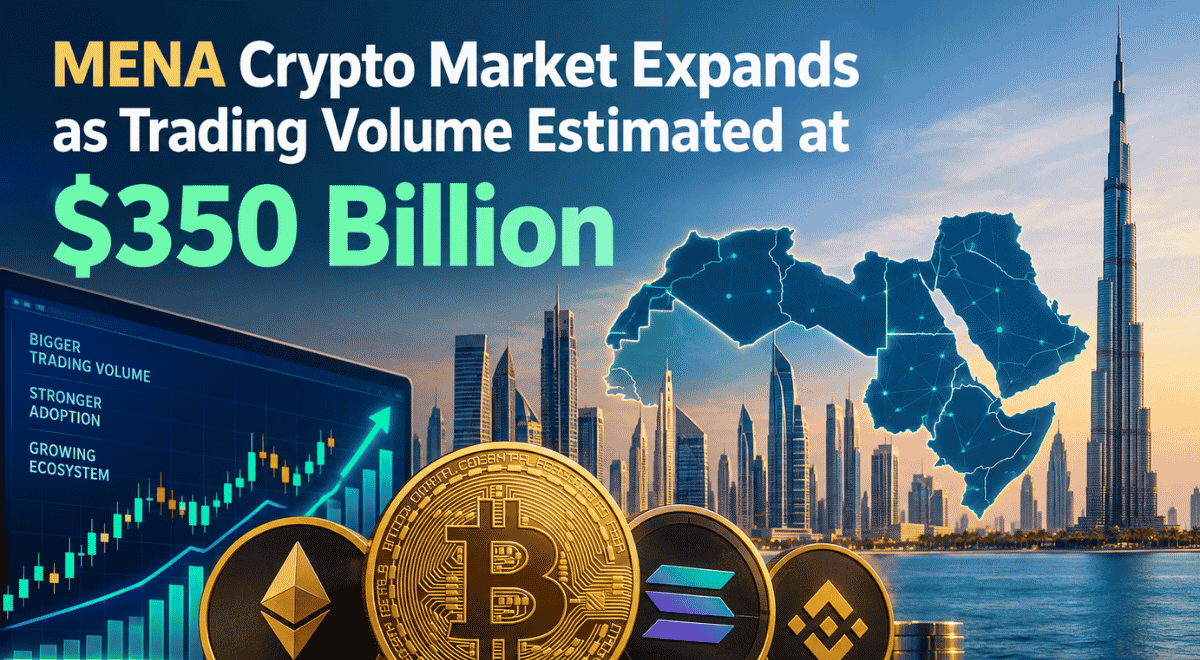
The Middle East and North Africa (MENA) cryptocurrency market has emerged as one of the world’s fastest-growing digital asset regions, with crypto transaction volume estimated to have reached $350 billion during the 2025–2026 period, according to a report from the Bitcoin Policy Institute.
The institute links the region’s rapid expansion to several factors, including persistent inflation, currency depreciation, government-backed technology initiatives and rising participation from institutional investors.
However, the $350 billion figure should be viewed as an estimate rather than a confirmed transaction total for a single calendar year. The report covers the 2025–2026 period and does not provide one underlying dataset or a detailed methodology explaining how the regional figure increased from an earlier estimate of $100 billion.
The report also highlights two different patterns of cryptocurrency adoption across MENA.
In countries facing high inflation, currency restrictions, sanctions or conflict, individuals have increasingly turned to Bitcoin and U.S. dollar-backed stablecoins as tools for preserving value and moving money.
In the Gulf, adoption has followed a different path. Countries in the region have focused on building regulated financial hubs capable of attracting cryptocurrency exchanges, institutional trading firms and tokenization platforms.
Transaction volume does not equal investment inflows
The distinction between transaction volume and investment activity is important when assessing the size of the regional crypto market.
A high transaction volume does not necessarily mean that more money is entering the region, that investors are generating profits or that the number of cryptocurrency users has increased by the same amount.
On-chain estimates can also capture transfers between wallets controlled by the same cryptocurrency exchanges, as well as repeated movements of the same assets. As a result, transaction volume should not automatically be interpreted as a measure of new capital entering the MENA market.
Turkey remains the region’s largest crypto market
Turkey stands out as the largest market in MENA by transaction value, with nearly $200 billion in annual cryptocurrency transaction volume, according to the Bitcoin Policy Institute.
The country’s strong cryptocurrency demand has developed against a backdrop of prolonged inflation and significant weakness in the Turkish lira.
Stablecoins have become particularly relevant in such an environment because dollar-pegged digital assets can provide users with digital exposure to the U.S. dollar. However, stablecoins also carry risks involving issuers, cryptocurrency platforms and changing regulations.
Egypt, Lebanon and Iran have experienced similar forms of crypto adoption, although economic and regulatory conditions vary considerably between the countries.
In Egypt, the institute reports that peer-to-peer Bitcoin trading rose by more than 300% following successive devaluations of the Egyptian pound. The report does not specify the complete dataset or measurement period supporting the figure, meaning it should be considered an estimate rather than a precisely verifiable market statistic.
Geopolitical tensions create mixed crypto reactions
Geopolitical instability has also influenced cryptocurrency markets across the region.
When tensions between Israel and Iran escalated in June 2025, Bitcoin initially moved lower alongside other risk assets. According to the institute, the overall cryptocurrency market declined by about 3.7%, while Bitcoin fell approximately 2.3% and Ether dropped 7.5%.
The market subsequently showed signs of investors moving away from smaller cryptocurrencies and toward Bitcoin. The report said Bitcoin’s market dominance climbed to 64.8%.
The shift suggests that investors may have viewed Bitcoin as relatively more resilient than many altcoins during periods of market stress. However, the data does not establish that Bitcoin consistently functions as a traditional safe-haven asset.
Previous market reactions have also demonstrated the opposite. Renewed U.S.–Iran tensions during a later episode pushed Bitcoin lower, highlighting how geopolitical uncertainty can trigger broad risk reduction across digital assets.
Saudi Arabia and Qatar show strong long-term growth
The Gulf has become another important part of MENA’s cryptocurrency expansion, with Saudi Arabia and Qatar recording some of the region’s highest reported growth rates.
Saudi Arabia posted a 154% year-over-year increase, while Qatar recorded growth of 120%, according to figures cited by the Bitcoin Policy Institute.
Those percentages, however, come from a Chainalysis regional study published in September 2024 rather than from newly measured 2026 data.
The timing is significant because the figures should not be interpreted as current 2026 growth rates without comparable, up-to-date measurements. Instead, the Bitcoin Policy Institute uses the earlier data to illustrate the longer-term momentum of cryptocurrency adoption across the Gulf.
Overall, MENA’s crypto market is being shaped by two parallel forces: economic pressures are driving grassroots adoption in several countries, while regulation, investment and technology initiatives are helping Gulf economies position themselves as institutional digital-asset hubs.
The estimated $350 billion in regional transaction activity highlights the scale of that expansion, but differences in measurement methods and data periods mean the figure should be interpreted as an indicator of market activity rather than a precise measure of new investment or cryptocurrency ownership.