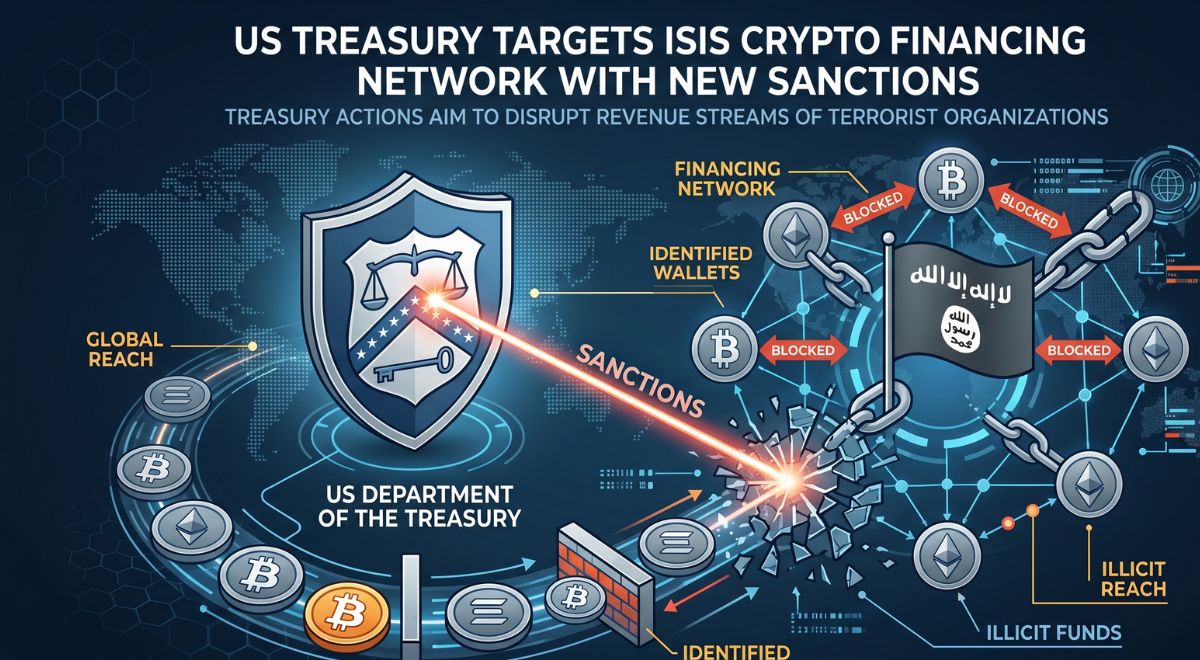
The United States Treasury Department has imposed sanctions on three individuals and six entities accused of facilitating financial transactions for the Islamic State of Iraq and Syria (ISIS), in a coordinated effort to disrupt the group’s international funding network.
Announced by the Office of Foreign Assets Control (OFAC) on June 22, the sanctions target a network spanning Syria, Turkey, France, and Nigeria that allegedly used money service businesses, currency exchange firms, and cryptocurrency transactions to transfer funds for ISIS operations across Europe, the Middle East, and West Africa.
The measures include sanctions against a Syria-based cryptocurrency exchange, two Turkish financial services firms, and three Nigerian currency exchange businesses, along with the individuals linked to their operations. OFAC also identified two TRON blockchain wallet addresses connected to a French national accused of supporting ISIS-related financial activities and distributing instructions on explosives manufacturing.
Table of Contents
ToggleSyria-Based Bitcoin Exchange Under Scrutiny
Among those designated is Abdelhakim Boukich, a Syria-based operator of Bitcoin Xchange, a money services business accused of facilitating transfers for ISIS affiliates. According to the Treasury Department, the exchange moved funds linked to ISIS supporters and associates in several countries, including Norway, Belgium, the Netherlands, South Africa, and the United States.
Boukich, who reportedly holds multiple aliases, was identified as the founder and director of the operation.
Turkish Firms Allegedly Linked to ISIS Financing
OFAC also sanctioned two Turkey-based companies—Spider Gayrimenkul Ve Genel Ticaret Limited Sirketi and Alkaram Danismanlik Gayrimenkul Ic Ve Dis Genel Ticaret Limited Sirketi. Authorities allege both firms are controlled by Mohamad Alhmidan, who was previously sanctioned for providing logistical and financial support to ISIS and assisting foreign terrorist fighters.
According to Treasury officials, Spider originally functioned as a hawala network facilitating transfers from ISIS-controlled territories, while Alkaram allegedly served as a front company supporting its activities.
French National and TRON Wallets Added to Sanctions List
The Treasury Department further designated French national Miloud Abderrahmane, accusing him of conducting transactions with ISIS-linked individuals in Syria and sharing bomb-making instructions with supporters of the extremist group.
As part of the action, OFAC added two TRON blockchain wallet addresses associated with Abderrahmane to its sanctions list. The move highlights the growing role of cryptocurrencies in counterterrorism investigations and marks one of the relatively rare instances where specific blockchain wallet addresses have been directly sanctioned.
Nigerian Currency Exchanges Targeted
The sanctions also extend to West Africa, where Nigerian national Mukhtar Adamu Muhammad was identified as a financial facilitator for ISIS-West Africa (ISIS-WA).
Authorities say Muhammad owns or controls three bureau de change businesses operating in Lagos and Kano—Nine to Nine Exchange Bureau de Change, Manhattan Bureau de Change, and Generation Currency Bureau de Change. All three entities were added to the sanctions list alongside Muhammad.
Growing Focus on Decentralized Terror Financing
The Treasury Department noted that increased counterterrorism pressure has pushed ISIS to rely more heavily on decentralized networks and regional financial facilitators. The latest sanctions reflect efforts to dismantle those evolving channels by targeting key actors operating across multiple jurisdictions.
Financial Restrictions Take Immediate Effect
Under the sanctions, all property and interests belonging to the designated individuals and entities that fall under U.S. jurisdiction are blocked. U.S. citizens and businesses are prohibited from engaging in transactions with them, while foreign financial institutions that knowingly facilitate dealings on their behalf could face secondary sanctions and restrictions on access to the U.S. financial system.
The action was carried out under Executive Order 13224, the primary U.S. counterterrorism sanctions authority, under which ISIS was originally designated as a Specially Designated Global Terrorist organization in 2004.
The latest measures follow separate sanctions imposed earlier this month on several Iran-linked cryptocurrency platforms, including Nobitex, as Washington continues to intensify efforts against networks accused of enabling illicit financial activity through digital assets.