
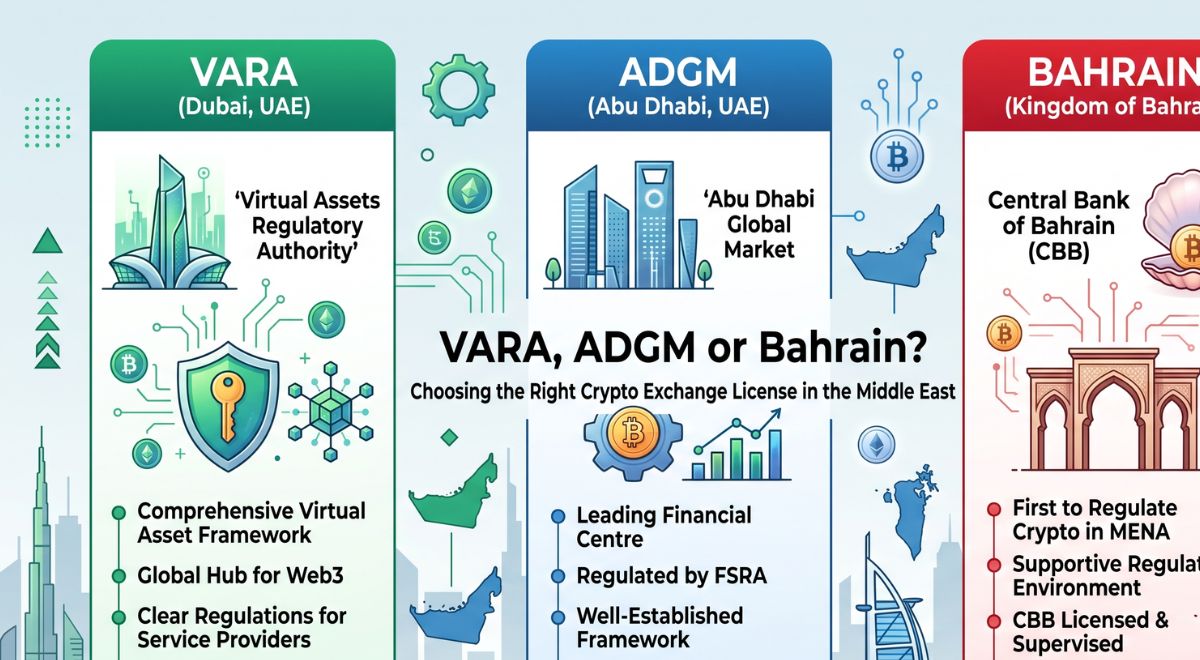
The Middle East has rapidly emerged as one of the world’s most attractive destinations for cryptocurrency exchanges seeking regulated expansion, with the UAE and Bahrain positioning themselves as leading digital asset hubs.
Among the region’s regulatory frameworks, Dubai’s Virtual Assets Regulatory Authority (VARA) has gained significant international attention, attracting major crypto exchanges looking to establish licensed operations. However, industry experts say that selecting a licensing jurisdiction requires more than following market trends or choosing the most recognized regulator.
Instead, exchanges should carefully evaluate whether Dubai’s VARA, the Abu Dhabi Global Market (ADGM), or Bahrain’s regulatory framework aligns best with their business model, customer base, compliance capabilities, and long-term regional ambitions.
Industry observers note that a crypto license serves as far more than a regulatory approval. It determines how an exchange operates, the types of clients it can onboard, the services it can legally provide, the infrastructure it must maintain, and the compliance standards it is expected to uphold throughout its operations.
As a result, licensing decisions should be viewed as strategic operational choices rather than simply selecting the fastest or most popular jurisdiction.
This article is based on insights shared during CoinGecko’s webinar, “Global Expansion Playbook for Exchanges: Where to Get Licensed Next & Common Bottlenecks.” It is intended for informational purposes only and should not be interpreted as legal, regulatory, or compliance advice. Businesses should seek professional legal guidance before making licensing decisions.
Business Model Should Drive Licensing Strategy
Experts emphasize that licensing discussions often begin with questions about geography, market access, and where competing exchanges are establishing operations. While these factors are relevant, they should not be the primary drivers of regulatory strategy.
Instead, exchanges should first assess their own operating model. Key considerations include the customer segments they plan to serve, the products and services they intend to offer, their corporate structure, the level of local presence they are prepared to establish, and the financial institutions and counterparties they expect to work with.
Different business models carry distinct regulatory requirements. Retail trading platforms, institutional brokerages, custody providers, over-the-counter (OTC) trading desks, and exchanges serving regulated institutional clients each face unique operational and compliance obligations when entering Middle Eastern markets.
Consequently, the most suitable jurisdiction is not necessarily the one with the highest profile, but the one that best supports an exchange’s long-term commercial and operational objectives.
Industry specialists also stress that obtaining a license is only the beginning of the regulatory journey. Licensed exchanges must continue to comply with ongoing governance standards, reporting obligations, risk management requirements, and supervisory expectations throughout the life of their operations.
For that reason, firms are encouraged to evaluate not only their ability to secure regulatory approval but also their capacity to meet the long-term compliance commitments required under each licensing regime.